Streaks: An Encouragement or a Discouragement in Learning?
Exploring how Duolingo streaks influence stress, consistency, and learning experiences
**Not affiliated with Duolingo
Team
Ananya Ratakonda, Annie Zuo, Mileyna Soo, and Quynh Tran
Methods
Surveys, Likert Scale, Open-Ended Questions, Quantitative analysis
Duration
8 Weeks
Role
UX Researcher
Overview
A pilot study exploring the relationship between Duolingo streaks, stress, and language learning.
Challenge
Streaks encourage consistent practice, but may also create pressure that affects users’ learning experience.
Approach
Conducted a pilot survey with 4 active Duolingo users using 5-point Likert-scale and open-ended questions over 4 days.
Findings
Streaks created both pressure and reward, while participants’ experiences varied across days and between passive and active language use.
Next Steps
Expand the study with a longer research period, semi-structured interviews, and diary studies to better understand users’ experiences over time.
Problem Statement
Duolingo’s gamified method of using streaks encourage consistency, but also can they create pressure that gets in the way of meaningful learning?
Consistency
Streaks encourage users to return and practice every day.
Pressure
Users may feel pressure to maintain their streak.
Learning
Users could prioritize maintaining their streak over meaningful engagement.
Background Research
Duolingo's streak feature is designed to encourage users to practice a language every day by rewarding consistency.
Before conducting our study, we looked at existing research on streaks, engagement, and gamification. Previous research has shown that streaks can increase engagement, strengthen habit formation, and motivate users to return to a platform. However, as users become more invested in maintaining their streaks, questions emerge about the emotional impact of these engagement mechanisms.
1. Streaks & Engagement: Research found that users interact more when they have an ongoing streak.
2. Streaks & Motivation: Research found that highlighting streaks and personalized positive reinforcement can increase engagement and attachment.
3. Our Concern: We observed that users may focus on maintaining their streak rather than meaningfully engaging with lessons.
While existing studies have explored how streaks influence user retention, less attention has been given to how they affect users' stress levels and learning experiences.
Research Question
How do streaks influence an individual when learning, more specifically, how does it affect their stress levels?
Methodology
We planned a qualitative interview study to explore how users are affected by Duolingo’s streak feature in correlation to stress. We also conducted survey research using Likert-scale and open-ended questions. For the pilot study, we focused on the survey portion and did not conduct interviews due to time constraints and the small sample size.
Participants
Pilot Study: 4 active Duolingo users with varying streak lengths. The participants ranged in age from 19 to 37, and most reported varying streak lengths and engagement levels with Duolingo. 2 participants had 100+ day streaks, while the other two had less than 25 days of streaks.
Survey
The survey consisted of Likert-scale statements measuring motivation, emotional connection, and stress. The survey also includes 2 open-ended questions asking participants to briefly explain, in their own words, how the streak feature has affected their learning experience, stress levels, or language confidence.
Sample 5-point Likert-scale statements (Strongly Disagree to Strongly Agree):
"I feel pressure to maintain my streak"
"Completing a lesson feels overwhelming"
"I feel rewarded after completing a lesson"
"I feel good knowing that I’ve kept my streak"
"I only complete lessons to maintain my streak"
"I do not look forward to lessons anymore"
"I have switched between multiple languages solely for the purpose of maintaining my streak"
Open-end questions:
1. Have you used the language you’re learning in public or casual conversation? If so, how has Duolingo affected your confidence in using that language?
2. How do Duolingo notifications or emails make you feel emotionally? Is it negative or positive? Do the notifications motivate you or make you tired?
Pilot Procedure
The procedure for our pilot study: Have participants fill out our survey after completing their Duolingo lesson, so we can understand their potential stress caused by their lesson.
Ideally, we would ask the participants to take the survey for a month, but due to time constraints, we plan on asking the participants to fill it out for 4 days after completing their lessons.
The pilot resulted in 11 responses across 4 participants.
Analysis
Quantitative responses were analyzed using means, standard deviations, and Cohen’s Kappa. Open-ended responses were coded thematically to uncover common experiences.
Key Findings
Our pilot study revealed that users’ experiences with Duolingo were not always consistent from day to day. While streaks appeared to encourage continued engagement, they also created pressure for some participants.
Responses varied over time
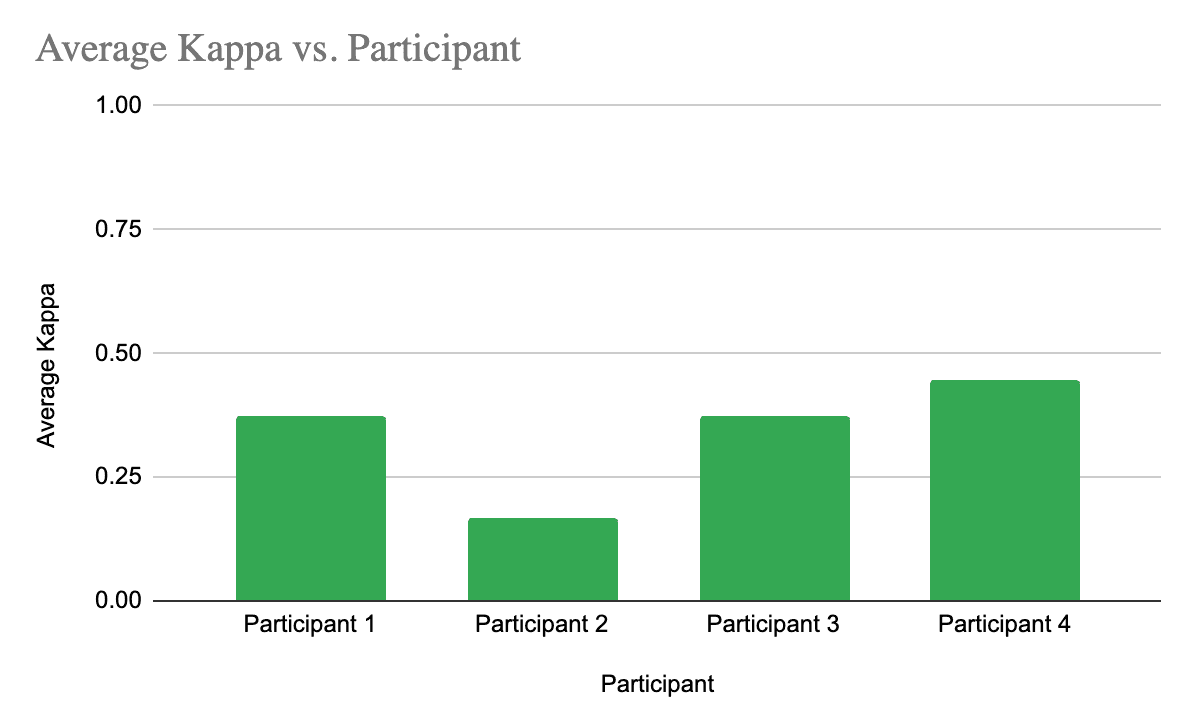
To understand how consistent participants were in their responses, we examined Cohen’s Kappa across repeated survey submissions. Based on the graph above, most participants had Kappa values between 0.17–0.44, indicating slight to fair agreement. This suggests that participants’ perceptions of Duolingo could shift from day to day, potentially reflecting differences in mood, workload, or recent app experience.
Streaks created both pressure and reward
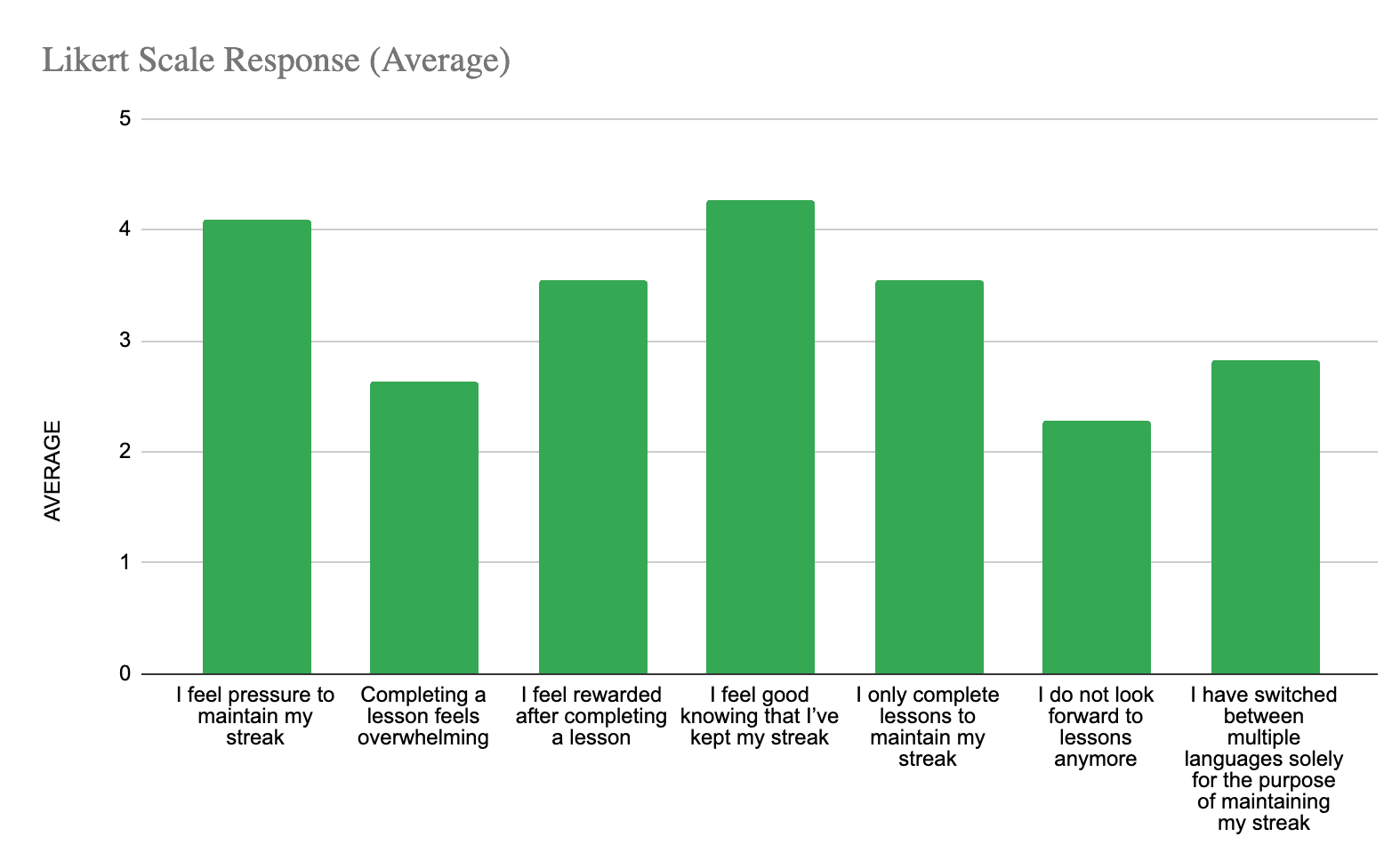
We also analyzed the average responses to our Likert-scale questions. Participants reported relatively high agreement with feeling pressure to maintain their streak, with an average of 4.09. At the same time, participants also reported feeling good knowing they had kept their streak, with an average of 4.27. In comparison, feeling overwhelmed by lessons had a lower average of 2.64.
Learning was stronger in reading and listening
Several participants had not used the language publicly, often due to limited opportunities or low speaking confidence. Many reported that Duolingo strengthened their reading and listening comprehension, highlighting a gap between passive learning and active language use. Others described using the language in casual or experimental conversations and making slow but steady progress in speaking.
Notifications created different emotional responses
Participants had mixed responses to Duolingo notifications. Some felt neutral toward them, while others experienced pressure or anxiety, particularly when they were busy or behind on lessons.
Reflection
This pilot showed us that the relationship between streaks and learning is more complex than simply encouraging users to practice consistently. While participants often felt rewarded by maintaining their streak, some also experienced pressure or anxiety. We also found that users’ experiences could vary from day to day, highlighting the importance of understanding the context behind repeated responses.
The pilot also showed us the limitations of a small sample and short study period. A longer study would help us better understand how users’ emotions, motivations, and language-learning experiences change over time.
Next Steps
For a larger study, we would extend the research period and include semi-structured interviews to better understand participants beyond their survey responses.
We would also explore diary studies to better understand participants’ emotions, motivations, and experiences with Duolingo over days and weeks. This would allow us to further examine whether streaks support meaningful learning or contribute to a more stressful experience.